
Why Wet Winters Leave British Pastures Battered
After a relentlessly wet British winter, even a well-managed paddock can look more like a building site than grazing ground. Repeated hoof traffic churns the surface, squeezes out air, smears soil into dense layers and leaves ruts that collect water. Gateways, feed points, water troughs and shelter belts usually suffer first, but compaction can spread much further across the field. If stock are turned out too early, fresh growth is pulled from poorly anchored roots and the damage becomes harder and more expensive to repair.
The first rule is simple: do not rush heavy machinery onto wet turf. A tractor, loader or contractor’s kit can create a deep pan that remains troublesome for years, particularly on clay and silty soils. Instead, begin with a spade, a careful inspection and a plan that keeps animals away from the worst areas. Sensible low-capital measures, including targeted slitting, temporary sacrifice areas, controlled harrowing and appropriate overseeding, can often restore useful grazing without commissioning a full reseed. For wider pasture-planning guidance, a practical rotational grazing guide can help turn recovery work into a longer-term system.
Assessing True Soil Damage with the Spade Test
A visual evaluation of soil structure, often called VESS, is a worthwhile first job because surface appearance does not always reveal the real problem. Choose one damaged area and one apparently healthy comparison area. When the ground is moist but not saturated, push a standard garden spade into the soil and lift a block roughly 30 centimetres deep. Open the block carefully and examine each layer rather than judging only the top few centimetres. The AHDB soil structure method provides a useful framework for looking at aggregates, pores, roots and layer boundaries.
Good soil breaks into rounded, friable aggregates, contains visible pores and allows roots to travel downwards. Damaged soil may break into hard blocks, angular clods or thin plates. A shallow layer of smeared soil with healthy soil beneath suggests superficial poaching, which may respond to light surface treatment and rest. A dense layer that resists the spade, shows horizontal root growth or holds water above it points to a deeper compaction pan. Machinery traffic can deepen this problem, especially when tyres carry high loads on wet ground, so the comparison pit is particularly helpful before choosing an implement.
Look for signs that the soil has lost air as well as structure. A stagnant or foul smell, grey or bluish colouring, mottling, standing water and a thin mat of short roots all suggest poor aeration. Do not confuse every wet patch with compaction, however. A high water table, blocked drain or naturally heavy soil may also be involved. Record where water sits, where roots stop and where livestock congregate. The most useful assessment notes include:
- Depth and thickness of any hard or smeared layer.
- Whether roots stop abruptly or continue through the layer.
- Presence of pores, earthworm channels and friable aggregates.
- Differences between gateways, troughs, slopes and undamaged ground.
- Any drainage, environmental or archaeological constraints before cultivation.
Tine Spiking Versus Slitting for Smallholder Budgets
Slitting and spiking are not interchangeable cures. Shallow grassland slitting normally works within approximately 0 to 10 centimetres, cutting through surface caps, matted vegetation and shallow compaction. It is suited to poached swards where rainfall is running off instead of soaking in, but it will not reliably break a hard pan deep in the subsoil. A small tractor-mounted slitter, pedestrian implement or suitable hired machine may be enough for a modest holding, provided the turf can carry the equipment without rutting.
Spiking or grassland aeration reaches deeper, commonly around 10 to 18 centimetres depending on the machine and soil. Tines or blades create channels that introduce air, improve infiltration and help roots explore surrounding soil. A compact tractor can often operate a lighter aerator, while deeper work may need more power and careful adjustment. If the pan lies below the working depth of an aerator, a subsoiler may be required, but this is a more disruptive and power-hungry operation and should not be attempted casually across a wet field.
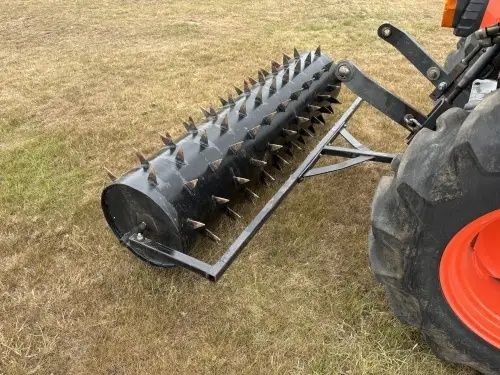
| Treatment | Best target | Ground conditions | Smallholder considerations |
|---|---|---|---|
| Shallow slitting | Surface capping and poaching to about 10 cm | Moist, firm and non-plastic | Lower power requirement and limited surface disturbance |
| Deep tine aeration | Compaction commonly reaching 10 to 18 cm | Moist but friable, never sticky | Requires suitable tractor capacity and careful depth setting |
| Subsoiling | Persistent deep pans below normal aerator depth | Dry enough to fracture rather than smear | Highest power demand and greatest risk if conditions are wrong |
Timing matters more than the badge on the implement. Soil should crumble around the tine rather than mould into shiny ribbons. If a slot closes immediately in wet plastic soil, the pass has probably smeared the problem rather than solved it. If the ground is bone dry, shallow tools may bounce and deep tines may lift large slabs. Work in a direction that respects drains and slopes, avoid unnecessary passes, and keep recently disturbed ground free from stock and traffic. Some grassland-slitting guidance recommends a long recovery period, around ten weeks, before reusing treated ground, although the exact interval depends on soil, weather and sward recovery.
Setting Up Sacrificial Holding Areas and Resting Windows
A sacrifice area is a deliberately chosen place where livestock can be held while the main paddocks recover. It may be an existing hard-standing yard, a well-drained corner with a stable surface, or a reinforced area near handling facilities. The aim is not to create perfect grazing, but to confine hoof damage to a manageable location. Put forage, water and mineral supplies in places that can be reached without creating a single deep mud hole, and check that runoff cannot flow directly into a ditch or watercourse.
Recovery time should be based on the condition of the soil and the speed of plant growth, not on a fixed date. Four to eight weeks is a sensible starting window for rebuilding air spaces and allowing roots to re-anchor, but saturated clay may need longer. A field can look green while its lower structure remains weak. Press a heel into the surface, inspect a small root block and watch whether hoof marks deepen after rain. Rotational grazing guidance stresses that recovery periods vary from roughly 20 to 30 days in rapid spring growth to 40 to 60 days or more in slow or drought conditions.
- Move stock to the sacrifice area before the pasture becomes saturated, rather than waiting for severe poaching.
- Divide sound grazing into narrow corridors with electric tape and give each section a defined rest period.
- Begin grazing only when the sward is rooted, the surface carries a hoof and grass has regained useful height.
- Remove animals before they graze down to the crown or begin congregating around gateways and water.
Once roots start re-anchoring, temporary fencing makes a major difference. Small paddock divisions allow animals to harvest a controlled amount without repeatedly crossing the whole field. Keeping grass at a reasonable height protects the growing point and leaves leaf area for rapid recovery. On equestrian holdings, track systems and surfaced gateways can deliver similar benefits, particularly where horses repeatedly walk the same routes. The spending is modest compared with repairing every paddock after another wet winter.
Harrowing and Overseeding Bared Ground
Harrowing should be used with purpose, not simply because the field looks untidy. Chain harrows can level light hoof ruts, spread dung and pull out dead thatch, while spring-tine rakes provide more aggressive disturbance where a cap or thick mat is restricting seed contact. Avoid dragging a wet, sticky surface into long smeared ridges. The ground should be sufficiently dry for the implement to crumble and level, but not so dry that existing roots are torn out unnecessarily.
Overseeding is often the economical middle ground between doing nothing and paying for a complete reseed. Perennial ryegrass can provide durable grazing, white clover can contribute nitrogen fixation and feed value, and carefully chosen forage herbs can improve diversity. The right mixture depends on soil, drainage, livestock and intended use. A wet, heavy field should not automatically receive a mixture designed for free-draining land. Before buying seed, test soil pH and nutrients, identify weeds and estimate how much of the existing sward remains productive.
- Use perennial ryegrass for persistent production where soil and management suit it.
- Include white clover where grazing pressure, pH and fertility allow establishment.
- Consider plantain, chicory, yarrow, sainfoin or birdsfoot trefoil for a more diverse sward.
- Keep small seeds shallow; burying them too deeply can prevent emergence.
- Match the seed mix to drainage, livestock type and the length of time the ley must last.
Prepare only when the existing vegetation will not outcompete new seedlings. A close graze followed by vigorous but controlled harrowing can open the sward. Broadcast or drill seed according to the mixture, then roll with a flat roll or Cambridge ring roller to press seed into the soil without sealing it. Good seed-to-soil contact is essential, particularly when spring rainfall is intermittent. The cost of a full reseed can be approximately £400 to £700 per hectare, so targeted overseeding is worth considering where enough desirable grass and clover remain. If less than about 60 per cent of the sward is made up of useful sown species, or if weeds and compaction dominate, a larger renewal plan may be more sensible.
Natural Bio-Remediation with Deep-Rooting Herbal Leys
Herbal leys offer a biological way to improve soil over time. Chicory and plantain produce strong roots that explore lower layers, while sainfoin and other legumes contribute diversity and can support nitrogen supply when conditions are suitable. These roots create channels as they grow and decay, helping water and air move through the profile. They will not magically repair a severely compacted pan in one season, but they can complement targeted aeration and reduce dependence on repeated mechanical intervention.
A diverse sward can also improve drought tolerance, nutrient cycling and forage quality. Deep-rooted plants may continue finding moisture during a dry spell, while varied rooting depths help capture nutrients that shallow grass roots leave behind. Better infiltration reduces rapid runoff from compacted surfaces, which is valuable on sloping paddocks and near streams. Establishment still requires careful soil preparation, sensible grazing and patience. Some herbs prefer free-draining ground, and a failed mixture caused by unsuitable conditions is an avoidable expense.
- Choose a mix containing compatible grass, legume, herb and wildflower species.
- Correct pH and major nutrient problems before sowing rather than expecting roots to overcome them.
- Allow a long establishment period and avoid close grazing while seedlings are vulnerable.
- Watch for toxic or unsuitable species where particular livestock are sensitive.
- Keep field records, seed invoices and photographs if applying for environmental support.
Eligible land managers in England should check the current CSAM3 herbal leys action. The published Sustainable Farming Incentive 2026 guidance describes a three-year action paying £224 per hectare per year, subject to eligibility and specific requirements. These include at least one grass, two legumes and two herb or wildflower species, limits on inorganic nitrogen, and periods when the ley is rested from grazing or cutting. Rules, dates and eligibility can change, so confirm the latest conditions before committing seed or altering a field covered by another agreement.
Reclaiming Your Grazing Ground for the Coming Season
Successful pasture recovery is mostly a matter of restraint. Test the soil before selecting an implement, distinguish surface poaching from deep compaction, and only aerate when the ground is moist enough to work but friable enough not to smear. Where damage is severe, a sacrifice area protects the remaining fields. Where the sward is thin but still viable, harrowing, overseeding and rolling can restore cover at a fraction of the cost of a full reseed. Herbal leys then provide a longer-term route towards stronger rooting and better water movement.
This weekend, walk every paddock with a spade, mark the worst zones, inspect one good comparison area and photograph the evidence. Move stock away from saturated ground, check drains and gateways, and set out electric tape for the first recovery rotation. As the weather improves, wait for the right surface conditions before making a single well-planned mechanical pass. Consistent rest, controlled grazing and reduced traffic will do more for next winter’s resilience than a hurried operation carried out on wet soil.

