
Why British Farms Are Turning Roof Runoff into Free Water
Metered water charges are an increasingly noticeable cost on British farms. Livestock drinking points, parlour cleaning, machinery washdown, yard sweeping and general maintenance can all add to the bill, particularly where water is being used several times each day. At the same time, barns, workshops, grain stores and livestock buildings offer a useful resource above ground: large roof areas that collect rainfall whenever a weather front moves across the holding.
Why pay for mains water for every outdoor task when clean roof runoff can handle much of the demand? A well-planned system does not need to be a polished commercial package. Standard agricultural gutters, drainage fittings, reclaimed food-grade tanks, mesh screens and simple gravity pipework can provide dependable utility water at a fraction of the usual installation cost. The basic principles are explained clearly in traditional rainwater harvesting methods, allowing farms to adapt existing buildings rather than purchase an expensive all-in-one kit.
Calculating Roof Catchment Potential Against Local Rainfall
Begin with the horizontal footprint of the roof, not the sloping surface. Measure the length and width of the roof area draining towards the chosen gutter, then multiply the two figures. A roof measuring 30 metres by 12 metres therefore provides a nominal catchment area of 360 square metres. The roof pitch does not normally need to be added to the calculation because rainfall is measured as a vertical depth, while the horizontal footprint represents the area receiving that rain.
Regional conditions make a considerable difference. Western uplands and exposed parts of Wales, Cumbria, Scotland and the South West may receive much more rain than sheltered eastern counties. Even within one farm, rainfall can be highly seasonal, with long dry spells followed by intense storms. The Isle of Wight”s rainfall pattern, for example, is not directly comparable with that of a western hill farm, so a local gauge or nearby long-term rainfall record is more useful than relying on a national average.
A practical estimate uses this formula: roof area in square metres multiplied by rainfall in millimetres gives the theoretical collection volume in litres. A 360 square metre roof receiving 700 millimetres of annual rain could therefore intercept 252,000 litres. In reality, allow for gutter overflow, moss, roof friction, first-flush diversion, evaporation and leaks. Applying an efficiency factor of 75 to 85 per cent gives a more realistic annual yield of roughly 189,000 to 214,000 litres.
| Calculation stage | Example for a 360 square metre roof | Purpose |
|---|---|---|
| Roof footprint | 30 m x 12 m = 360 m² | Establishes the collection area |
| Annual rainfall | 700 mm | Use a local or nearby long-term figure |
| Theoretical yield | 360 x 700 = 252,000 litres | Maximum before losses |
| Practical yield | About 189,000 to 214,000 litres | Allows for ordinary system inefficiencies |
| Storage requirement | Based on demand and dry spells | Annual yield is not the same as tank size |
Storage should be matched to actual use rather than the annual total. A farm may collect plenty of water across a year but still run short after several dry weeks if the tank is too small. Estimate daily demand for washdown, livestock and yard jobs, then compare it with the likely rainfall pattern. Research discussed in Rainwater Harvesting for Livestock and Agriculture cites ADAS estimates of £31 to £100 per dairy cow each year for water. That figure is not a guaranteed saving, but it shows why even partial substitution can be worthwhile on a larger holding.
Building Simple First-Flush Diversions and Mechanical Gutter Screens
Roof water should not be sent straight into a tank without basic protection. Dust, bird droppings, moss fragments, insects, grit and airborne agricultural particles can collect on a roof between rain events. The first part of a storm then washes much of this material into the gutter. A first-flush diverter temporarily receives that initial dirty flow before allowing cleaner water into storage.
A robust farm version can be made from standard PVC drainage pipe. Fit a vertical section beneath the downpipe, add a ball or flap arrangement to restrict the initial flow, and provide a small drain or screw cap at the base. The pipe must be secured firmly because a full column of water is heavy. Its capacity depends on the roof area and local dirt load, but a larger diversion is generally sensible for buildings surrounded by trees, livestock yards or dusty tracks.
- Fit a coarse gutter screen or brush at the roof edge to catch leaves and larger debris.
- Connect the downpipe to a vertical first-flush chamber using standard drainage fittings.
- Add a threaded screw-cap clean-out at the lowest point so settled grit can be removed without dismantling the system.
- Route the cleaner overflow into the storage tank through a screened inlet.
- Inspect the screen and flush the chamber at the start of autumn and again after heavy leaf fall.
Gutter brushes are useful where leaves are a recurring problem because they reduce blockages without requiring frequent ladder work. Where finer protection is needed, galvanised wire mesh can be fixed beneath a removable frame. Avoid mesh so fine that it clogs after one storm. The best arrangement is usually staged filtration, with a coarse outer screen, first-flush diversion and a final tank inlet screen.
Sourcing and Setting Up Low-Cost Modular Tank Storage
Food-grade Intermediate Bulk Containers, commonly called IBCs, are often a practical starting point. They are widely available in 600 or 1,000 litre sizes, can be moved with suitable handling equipment and allow storage to grow as the system proves its value. Check the previous contents carefully. Containers that held chemicals, fuels, pesticides or unknown substances should not be used for water intended for animals, gardens or cleaning.
Several IBCs can be joined with large balance pipes near their lower outlets so that water levels equalise across the group. Use full-bore fittings where possible, include isolation valves for each container and fit unions that allow one tank to be removed for cleaning. Modular storage is especially useful beside long farm buildings because capacity can be distributed across several bays instead of creating one enormous tank and a complicated pipe run.
- Use only containers with a traceable, suitable previous use.
- Inspect cages, valves and seals before filling.
- Cover every opening against insects, rodents and falling debris.
- Keep sunlight off the water with opaque wraps, purpose-made covers or a durable dark external coating.
- Leave access around tanks for valve operation, inspection and cleaning.
Algae thrives when stored water is exposed to light, so opaque protection is more than a cosmetic improvement. Tanks should stand on a level, well-drained and properly compacted base. Do not rely on a few paving slabs under the corners of an IBC. A full 1,000 litre container weighs roughly one tonne, creating concentrated loads that can crack weak concrete or cause uneven settlement.
Where an existing hardstanding needs renewal, the RP15 concrete yard renewal guidance explains the standards and eligibility conditions for supported work under Capital Grants 2026. The guidance includes a concrete base at least 150 millimetres thick over at least 150 millimetres of compacted and blinded hardcore, together with reinforcement and sealed joints. RP15 is not a general tank subsidy, and it applies only in specified circumstances, so planning advice and scheme conditions must be checked before work begins.
A sound base protects both the tank and the yard. It also helps prevent clean roof water becoming mixed with slurry, dirty yard runoff or effluent. Keep the tank on the clean-water side of the drainage layout, and ensure overflow is directed somewhere that will not create erosion or pollution.
Plumbing Gravity Lines for Machinery Washdown and Field Troughs
Gravity is the cheapest pump available, provided the tank is higher than the point of use. Every metre of vertical difference creates useful pressure, although friction in long or narrow pipes reduces the flow. Place storage on a raised platform only where the structure has been professionally assessed for the load. In many cases, using a naturally higher barn corner or bank is safer than building an improvised tower.
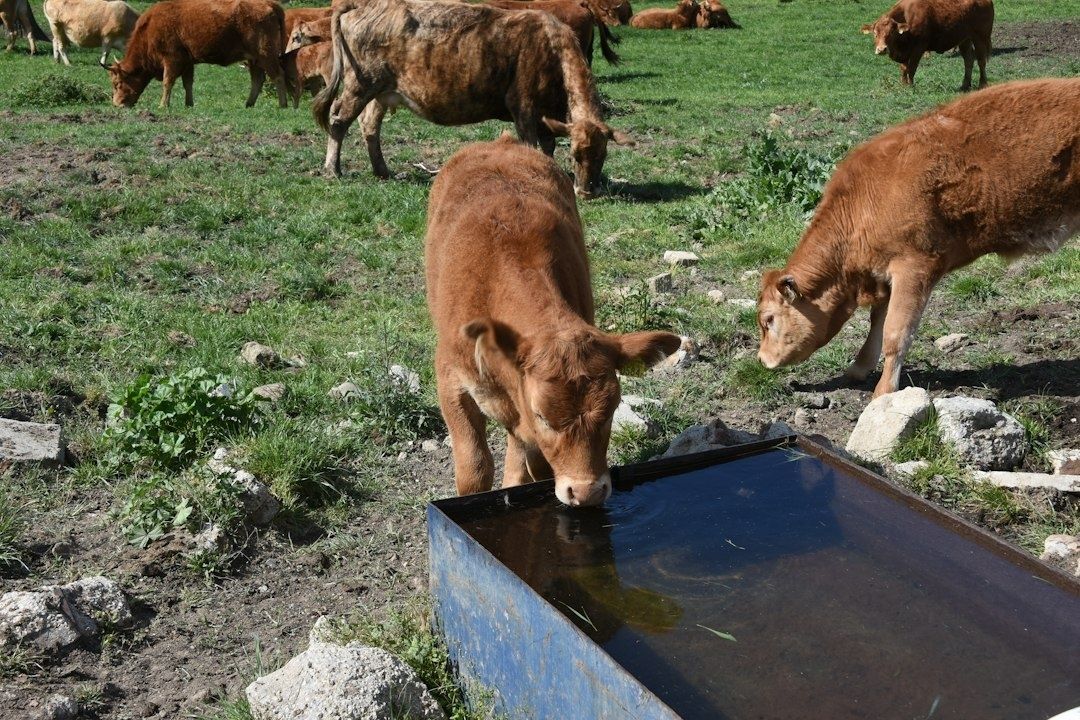
For machinery washdown, use a generously sized delivery line and keep bends to a minimum. A low tank outlet, full-bore valve and short run will provide a better flow than a long length of small hose. Gravity water may be suitable for soaking mud, rinsing wheels and general yard cleaning, but it may not deliver the pressure required by every pressure washer. A booster pump can be added later if the pilot system demonstrates sufficient stored volume.
- Install an isolation valve directly at each tank outlet.
- Fit a coarse filter before pumps, pressure washers or small valves.
- Use separate pipework for non-potable water and mains drinking supplies.
- Label tanks and taps clearly so nobody mistakes harvested water for drinking water.
- Provide overflow routes that cannot discharge contaminated water into a ditch or stream.
Washdown water can contain soil, nutrients, bacteria, oil, fuel and cleaning chemicals. A washdown pad should therefore be impermeable, easy to clean and connected to an appropriate drain, sediment trap, oil separator or containment system. Keep dirty water away from clean roof runoff and local watercourses. This is not only good environmental practice, but also a sensible biosecurity measure because cleaning wheels and machinery reduces the movement of soilborne pests, weeds and disease between fields.
Winter protection matters in exposed yards. Bury vulnerable pipes below the local frost depth where practical, insulate exposed sections and arrange low points with drain-down valves. Before hard frosts, close the tank outlet and empty above-ground hoses, filters and pressure-washer lines. A pipe that freezes while isolated can split fittings or damage valves, leaving an avoidable repair in spring.
The potential financial return can be assessed against the farm”s metered use. Guidance on agricultural harvesting systems, including estimates of livestock water expenditure, is set out in documented farm rainwater savings. Actual payback depends on the tariff, roof area, rainfall, storage, livestock numbers and how regularly the water is used, but gravity-fed distribution keeps running costs low once the infrastructure is installed.
Put Your Outbuilding Roofs to Work This Season
A farm roof can provide a substantial reserve of utility water without the cost of a proprietary harvesting package. The essential elements are straightforward: measure the catchment, fit a first-flush diversion, screen the gutters, store the water in suitable covered tanks and distribute it through safe, maintainable pipework. Each stage removes a common source of trouble, from dirty tank water to blocked valves and unstable foundations.
Start with one barn or machine shed rather than attempting a holding-wide installation immediately. Record rainfall, tank levels, water use and the volume of mains water displaced over several months. If the pilot performs well, add another IBC group, extend the guttering or run a gravity line towards a lower yard or paddock. Done carefully, this approach turns unused roof runoff into a practical buffer against rising water charges, dry spells and pressure on the farm”s mains supply.

